
Your tax return shows a loss. Here is how a bank reads it.
Depreciation makes a profitable building look like it loses money. Bank underwriters know that, and most of them add it back. Here is what that means for a full-documentation apartment loan, and where it stops helping.
By Capituro6 min read
- On a DSCR loan your tax return is not used at all. On a bank loan it is, and depreciation is added back to your cash flow.
- A cost segregation study creates a large first-year loss on paper. Banks add that back too, when you show them the study.
- What does not get added back: real losses, unpaid taxes, and a global cash flow that does not cover your other debts.
The problem every apartment owner runs into
You bought a 24 unit building three years ago. It cashflows. You paid yourself out of it last year. Then a bank asks for two years of returns, and Schedule E shows a loss on the property both years.
Nothing is wrong with the building. Depreciation is doing exactly what it is supposed to do. A $2.4 million building with $2 million of that allocated to the improvements writes off about $73,000 a year on a straight 27.5 year schedule, and that is before you count the roof, the parking lot, and the appliances. If you had a cost segregation study done, the first year loss can be several times that.
The question is what underwriting does with it.
Two kinds of loans, two answers
Investor loans sized on the property (DSCR). Your tax return is not part of the loan. Underwriting takes the rent roll, builds NOI with a standard vacancy and expense set, and divides by the payment. Depreciation never comes up. This is the simplest path when the return is ugly, and our DSCR programs go to 75% on a refinance without it.
Full-documentation bank-style loans. Underwriting does look at your returns, both the property's Schedule E and your personal 1040 or the entity's 1065. This is the lane where the rate is usually better, the amortization shorter, and the relationship matters. It is also the lane where a paper loss can scare an owner off before they ever apply.
It should not, in most cases. Here is what the underwriter actually does.
What gets added back
Full-doc underwriting is trying to find cash flow, not taxable income. Starting from the bottom line on Schedule E, they add back:
- Depreciation. All of it, every year. This is the single biggest adjustment on most apartment loans.
- Amortization of loan costs and other intangibles.
- Interest, because they are going to test the building against their own proposed payment, not the old one.
- One-time items you can document: a roof replacement expensed instead of capitalized, a legal settlement, a large turnover year.
What comes out on the other side is something close to NOI. That number, not the loss on the return, is what gets tested against the payment on the new loan.
A cost segregation study is a bigger version of the same thing. The study reclassifies part of the building into 5, 7, and 15 year property, and bonus depreciation lets much of that be written off at once. The result is a first-year loss that can exceed the building's entire gross rent. An underwriter who sees a $400,000 loss on a building with $300,000 of rent is going to ask questions. The answer is the study itself. Send it with the returns, and the depreciation line on Form 4562 will tie out to it. Once that ties, the loss is added back like any other depreciation.
If your Schedule E shows a loss and you have a cost segregation study, we can read it the way full-doc underwriting does and tell you which lane fits before anything is ordered.
What does not get added back
This is where owners get surprised, so it is worth being direct.
- Real operating losses. If the building lost money before depreciation, because rents were low or expenses were high or half the units were down for renovation, that loss is real and it stays.
- Distributions to yourself are not an expense, so they are not a problem. But a management fee paid to your own company is an expense, and it stays in unless you can show it was not actually paid.
- Global cash flow. Banks look at you, not just the building. They add up every property you own, your business income, your personal debts, and they want the total to cover the total. A building that clears 1.25x on its own can still be declined if the rest of your portfolio drags the global number under 1.0x. This is the part a DSCR lender never asks about.
- Unfiled or extended returns. A bank will wait for the return. It will not underwrite a projection in place of one.
The worked example: a 24 unit in Georgia
What the return showed. Gross rent $312,000. Operating expenses $128,000. Interest $84,000. Depreciation $71,000, plus a cost segregation study in year one that took the depreciation line to $296,000. Schedule E net: a loss of $196,000.
What we did. Added back depreciation of $296,000 and interest of $84,000 in our own review before the loan request went anywhere. Cash flow before debt: $184,000. Tested against the proposed payment on a $1.85 million loan at a 5 year fixed rate on a 25 year amortization, about $150,000 a year. Coverage: 1.23x. Cleared the bank's 1.20x floor.
What it means. The owner had been told by a residential lender that the loss disqualified him. It did not. We closed it on full-doc terms at a 5 year fixed, because the depreciation was the only thing between a profitable building and a return that said otherwise.
Figures are rounded and the property is not identified. Terms vary by lender and change without notice.
Same situation? Two years of returns, the study if there is one, and the rent roll is enough for a first read.
What to send so the add-back is easy
Underwriting that has to reconstruct your cash flow from a messy return will be conservative. Make it easy:
- Two years of the entity return or Schedule E, complete, with all statements and Form 4562.
- The cost segregation study, if there is one, with the engineer's summary page on top.
- A trailing twelve month operating statement from your property management software, which should tie to the return within reason.
- The current rent roll.
- A one-page note explaining any one-time expense over $10,000, with the invoice.
- A personal financial statement and a schedule of real estate owned, because global cash flow is coming either way.
Frequently asked
Will a bank lend on a building that shows a loss on Schedule E?+
Does a cost segregation study hurt my chances of a bank loan?+
Is it simpler to just use a DSCR loan and skip the tax returns?+
What is global cash flow and why does it matter?+
See it on your building.
Apartment DSCR Calculator
build NOI the way underwriting does and see whether a proposed loan clears 1.20x.
Open the calculator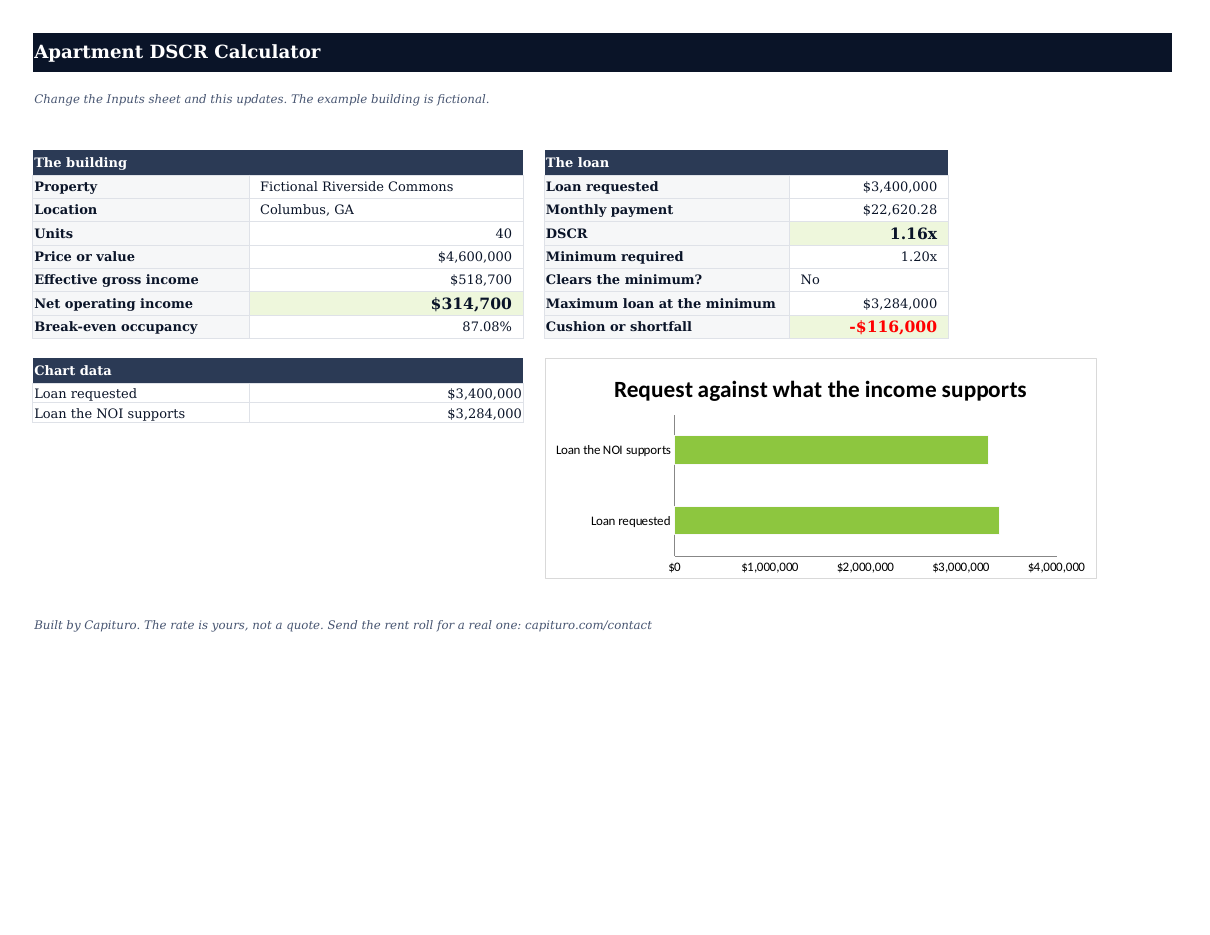
Where this leads next
10+ Unit Apartment Refinance
Refinance larger apartment buildings on the property's income.
OpenGeorgia Apartment Building Loans
Where we close on apartment buildings across Georgia.
OpenBank loan or 30 year loan
The two most common ways to finance a stabilized apartment building are built for different owners.
OpenSend the return and the rent roll for a real read.
We will review the loan request the way full-doc underwriting does, and tell you which lane fits before you order anything.