
How a single-tenant net lease property gets financed.
A pharmacy on a corner lot, a quick-service restaurant on an outparcel, a distribution building with one tenant and fifteen years left. The building matters less than the lease, and the lease matters less than who signed it.
By Capituro7 min read
- Underwriting reads the tenant's credit and the lease term first, the real estate second.
- Typical terms on a credit-tenant net lease: 60% to 65% loan-to-value, 1.30x to 1.35x coverage, 5 year fixed or 5+5, 25 to 30 year amortization, and on some of our programs, no prepayment penalty at all.
- The loan usually matures before the lease does. That is the point. What underwriting worries about is the reverse.
What net lease means to a lender
A triple net lease puts taxes, insurance, and maintenance on the tenant. The owner collects rent and pays the mortgage. For underwriting, that turns the property into something close to a bond: a fixed payment stream from a single obligor for a fixed term, secured by a building.
Which means the underwriting starts where a bond analyst would start. Who is the obligor, how long are they committed, and what is the building worth if they leave.
The tenant is the collateral
Corporate credit. A lease guaranteed by a national or regional company with public or rated financials is the easiest loan in commercial lending. Underwriting reads the guaranty, checks the credit, confirms the lease is assigned to the entity that actually has the balance sheet, and prices accordingly. Essential retail, national pharmacy, dialysis and other medical, and quick-service restaurants on corporate paper are in this group.
Franchisee credit. A well-known brand on the sign does not mean a corporate guaranty on the lease. Many quick-service and auto-service locations are leased to a franchisee operating company. Underwriting then looks at the franchisee: how many units, how long in business, personal guaranties, and the last three years of financials. A franchisee with twenty locations and a personal guaranty from a principal is a strong tenant. One with two locations and a two-year operating history is a local business with a national logo.
Local credit. A single-location operator on a net lease is underwritten like any small commercial tenant: business financials, the operator's personal financials, and a harder look at the real estate, because underwriting is planning for the possibility of re-leasing.
Send the lease and the guaranty. We will tell you which credit bucket the tenant lands in and what that does to the loan.
Lease term against loan term
Underwriting wants the lease to outlast the loan. A 5 year loan on a lease with 12 years left is comfortable. A 5 year loan on a lease with 4 years left is a loan against a vacancy, and it gets sized on what the building is worth empty.
The other direction is rare but real: a 20 year lease with 18 left does not get a 20 year loan from most depositories. They will write 5 years, or 5+5, and let the owner refinance. The tenant's commitment protects the loan; it does not extend the term.
Renewal options matter less than owners think. An option is the tenant's right, not the tenant's promise. We underwrite to the firm term.
Dark value
Net lease underwriting asks the same question every time: what is this building worth if the tenant goes dark? A pharmacy building on a hard corner in a growing suburb has a second life as something else. A purpose-built restaurant with a drive-through on a rural highway has a narrower one. A dialysis clinic built out for that use is somewhere in between.
That answer sets the LTV as much as the credit does. It is why two buildings with identical leases and identical tenants can get different loans, and why the appraiser is asked for a "dark" or "go-dark" value in addition to the leased fee value.
What the terms look like
On credit-tenant net lease, our bank-style programs usually read something like:
- Loan sizes from $1 million to $30 million, with the average well under $10 million
- Loan-to-value maximum of 60% to 65%, with exceptions when the coverage is strong
- Minimum coverage of 1.30x to 1.35x on a 25 or 30 year amortization
- 5 year fixed, priced off the 5 year Treasury, or a 5+5 with one reset
- Interest-only periods of 24 to 60 months on larger deals at some lenders, none at others
- Full recourse at most depositories; non-recourse exists at higher loan sizes on the securitized side
- Prepayment ranging from none at all on some of our programs to step-down to yield maintenance on others
- Underwriting assumptions of 5% vacancy and 5% management even on a triple net lease, plus a reserve of $0.15 to $0.25 per square foot
The "no prepayment penalty" line is worth reading twice. On a $5 million loan, the freedom to sell or refinance at any time without a step-down or yield maintenance is worth more than a quarter point of rate to most owners, and it is one of the few places our depository relationships beat the securitized market outright.
What some programs will not finance
Net lease is the property type with the longest exclusion lists. Different programs exclude different things, but the common ones are fitness centers and gyms, car washes, casual dining restaurants, hotels, and general office. Some exclude self storage. Some will not lend on government-assisted housing or to other financial institutions. Some require borrowers to be U.S. citizens. None of it reflects on the building, and all of it decides which program sees the loan request. We route by use before the first call ends.
1031 exchanges and timing
A large share of net lease purchases are 1031 exchanges, and the 45 day identification and 180 day closing clocks are real. We work inside those clocks on net lease all the time, and a clean package moves. The things that slow it down are the same things that slow every commercial loan: an incomplete lease (missing amendments, missing guaranty, missing estoppel), an environmental question on a site with a gas station or dry cleaner in its history, and a sponsor financial statement that arrives late.
The first look on a net lease loan request is short: the offering memorandum, the lease abstract or the lease itself, the sponsor's personal financial statement, and, on industrial, three years of tenant financials if they are available. Send those four and we can tell you in a day whether it is worth a full application.
Inside a 1031 window? Send the offering memorandum and the lease abstract today.
The worked example: a medical office building at $9 million
The building. A medical office building in a Southeastern metro, single tenant, corporate lease with a dialysis operator, more than ten years of firm term remaining.
The loan. Acquisition financing at 65% loan-to-value, a 7 year fixed on a 25 year amortization, with 24 months of interest-only at the front.
Why those terms. The tenant's credit carried the loan: corporate paper, long term, an essential-service use with a narrow but real dark value. The 7 year term ran well inside the lease. The interest-only period reflected the strength of the tenant and the comfort underwriting had with the coverage.
What it means. A local operator in the same building with five years left would have seen 60% or less, a 5 year term, no interest-only, and a harder look at what the building would rent for as general medical office. Same walls. Different loan.
Figures are rounded and the property is not identified. Terms vary by lender and change without notice.
Frequently asked
What loan-to-value can I get on a net lease property?+
Does underwriting care that the brand on the sign is a franchise?+
Why is my loan term shorter than my lease?+
What is dark value?+
Can I close a net lease loan inside a 1031 window?+
See it on your building.
Apartment DSCR Calculator
set the minimum DSCR to 1.35x, the vacancy and management to 5% each, and the reserve to the per-square-foot figure above. The sizing works for a single-tenant building. A net lease sizing template is coming to the Tools page.
Open the calculator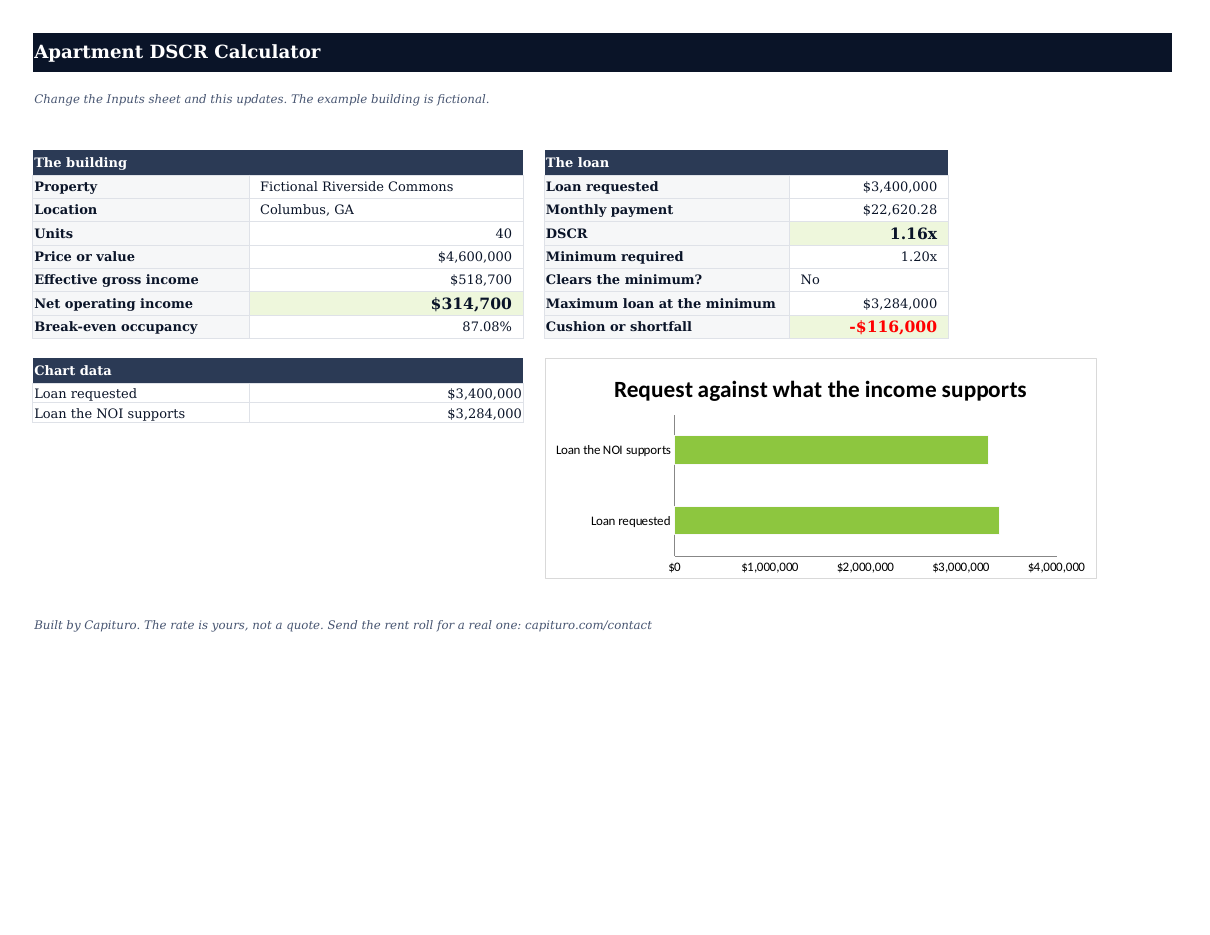
Where this leads next
Send the lease abstract and the guaranty for a first look.
We will underwrite the tenant, the term, and the building, and tell you which of our programs fits the credit and clears the exclusion lists.