
Your apartment loan comes due next year. Start here.
Most five year loans written in 2022 and 2023 mature in 2027 and 2028. The owners who handle it well start twelve months out, and the ones who handle it badly start at ninety days. Here is the order of operations.
By Capituro7 min read
- Twelve months out: read the note. Maturity date, extension options, prepayment schedule, and whether it resets or balloons.
- Nine months out: get the building's numbers clean and run them against today's rates, not the old ones.
- Six months out: pick the lane and start the application. A bank or agency takeout takes 60 to 90 days from a complete package, and appraisals add time.
Twelve months out: read the note, not the statement
The monthly statement tells you the balance and the payment. The note tells you what happens next. Pull it and find four things.
1. The maturity date and what happens on it. Some loans balloon: the full balance is due. Some reset: the rate changes to an index plus a spread and the loan continues. Some do both, with a reset at year five and a balloon at year ten. Know which one you have.
2. Extension options. Many bridge and some bank loans have one or two six or twelve month extensions, usually for a fee (a quarter to a full point) and usually conditioned on the building hitting a coverage test at the time. Read the conditions. An extension you cannot qualify for is not an option.
3. The prepayment schedule. On a 5-4-3-2-1 step-down, the penalty in year five is 1% of the balance, and it is usually zero in the last 90 days before maturity. That window matters: paying off in month 57 costs 1% and paying off in month 59 may cost nothing. On a yield maintenance or defeasance loan, the math is different and the penalty can be large right up to the end.
4. The rate reset formula, if there is one. If the loan resets to an index plus a spread, do the arithmetic today. A loan written at 4.25% that resets to a 5 year Treasury plus 2.75% is not a 4.25% loan anymore. Knowing the reset payment tells you whether "just let it reset" is a real choice.
Nine months out: get the numbers clean
Takeout underwriting runs on a trailing twelve month statement and a current rent roll. Nine months out is when to make sure those documents say what you think they say.
- Rent roll. Every unit, lease dates, current rent, deposits. Units that are month to month should be marked. Vacant units should show market rent, not zero.
- Trailing twelve. From your property management software, by month, matching your bank deposits. If you run the building out of a personal account, this is the moment to stop.
- The tax bill. If you bought in the last two or three years, Georgia counties may have reassessed. Underwriting uses the bill the building carries now, not the seller's old bill.
- Capital improvements. A list with dates and amounts. A new roof in year three is worth something to an appraiser only if it is on paper.
- Your own returns. If a bank is a candidate, two years of entity returns and a personal financial statement.
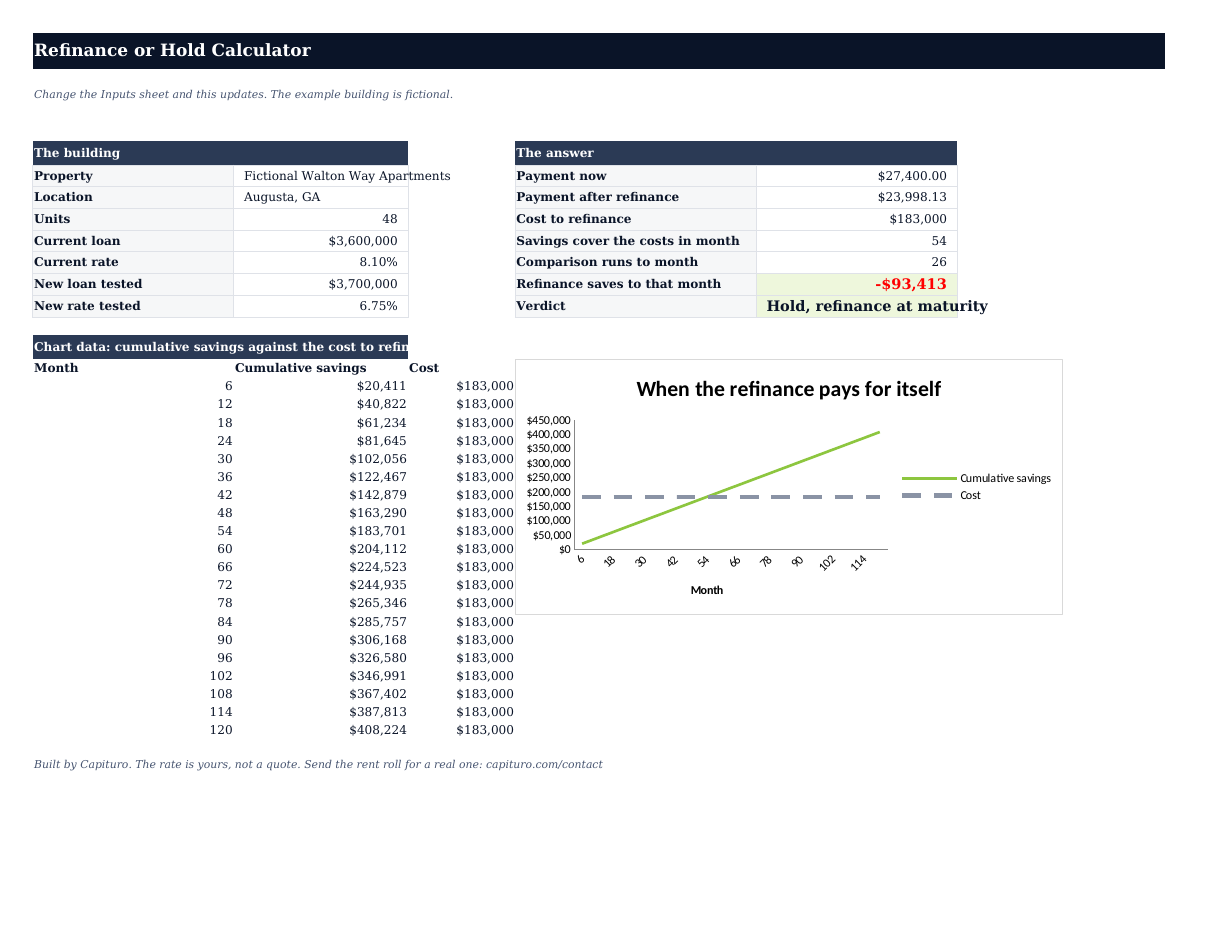
Then run the building against today's rates. Not the rate you got in 2022. If the building supported a $3.6 million loan at 4.5% and today's rate is 6.75%, it does not support $3.6 million anymore at the same coverage. The refinance-or-hold calculator on this site does that arithmetic in a few minutes. Better to know in month nine than month two.
Send the note and the rent roll now and we will run the building at today's rates, so you know in month nine whether the balance refinances clean.
Six months out: pick the lane and start the application
We run three lanes for a stabilized apartment building coming off a loan, and they take different amounts of time.
Bank-style full-doc. 5 year fixed, 20 to 25 year amortization, a personal guaranty, often a deposit relationship. Best pricing, most paperwork. 60 to 90 days from a complete package, and the appraisal alone is three to five weeks in most Georgia markets.
Agency small loan. Non-recourse, longer fixed terms, loan minimums that start around $750,000 at some lenders and $2 million at others. Slower to close, more third-party reports, and the best fit at moderate leverage on a clean building.
DSCR, sized on the property. 30 year fixed or hybrid, no tax returns, faster, up to 75% on a refinance. Higher rate than bank-style, step-down prepayment. The right answer when the returns are complicated, the timeline is short, or the loan is under the minimums above.
Six months is enough time for us to run one lane properly and fall back to a second if the first one stalls. Three months is enough to run one lane if nothing goes wrong. Ninety days is when owners take whatever is offered.
Three months out: the decision on the penalty
If your note has a step-down, look at the calendar. Closing in the last 90 days before maturity is often penalty-free. Closing a month before that window may cost 1% of the balance, which on $3 million is $30,000. Some owners lock the new loan and time the closing to the window. Others pay the 1% to remove the risk of a rate move. Both are reasonable. Deciding by accident is not.
Inside twelve months of maturity? Send the note. We will read the prepayment schedule and tell you the month to close.
What a forced extension actually costs
Owners who start late end up extending, and extensions are not free even when the fee is small. The rate often steps up. An updated appraisal or a coverage test is common. Some extensions require a paydown to hit a new LTV. And every month on a bridge or a matured loan is a month at a rate that was never meant to be permanent.
The cheapest refinance is the one that closes on schedule with a full package. The playbook above is how that happens.
Frequently asked
When should I start working on a refinance before my loan matures?+
Should I pay the prepayment penalty to refinance early?+
What if the building does not support the current balance at today's rates?+
Can I just let the loan reset instead of refinancing?+
Where this leads next
10+ Unit Apartment Refinance
Refinance larger apartment buildings on the property's income.
Open5 to 10 Unit DSCR
Long-term debt for smaller apartment buildings, sized on the rent roll.
OpenBank loan or 30 year loan
The two most common ways to finance a stabilized apartment building are built for different owners.
OpenSend the note and the rent roll a year early.
We will read the maturity terms, run the building at today's rates, and tell you which lane fits and when to start.