
Apartment refinance or hold calculator in Excel.
See whether refinancing an apartment loan pays for itself before your holding period ends or your current loan matures, and in which month.
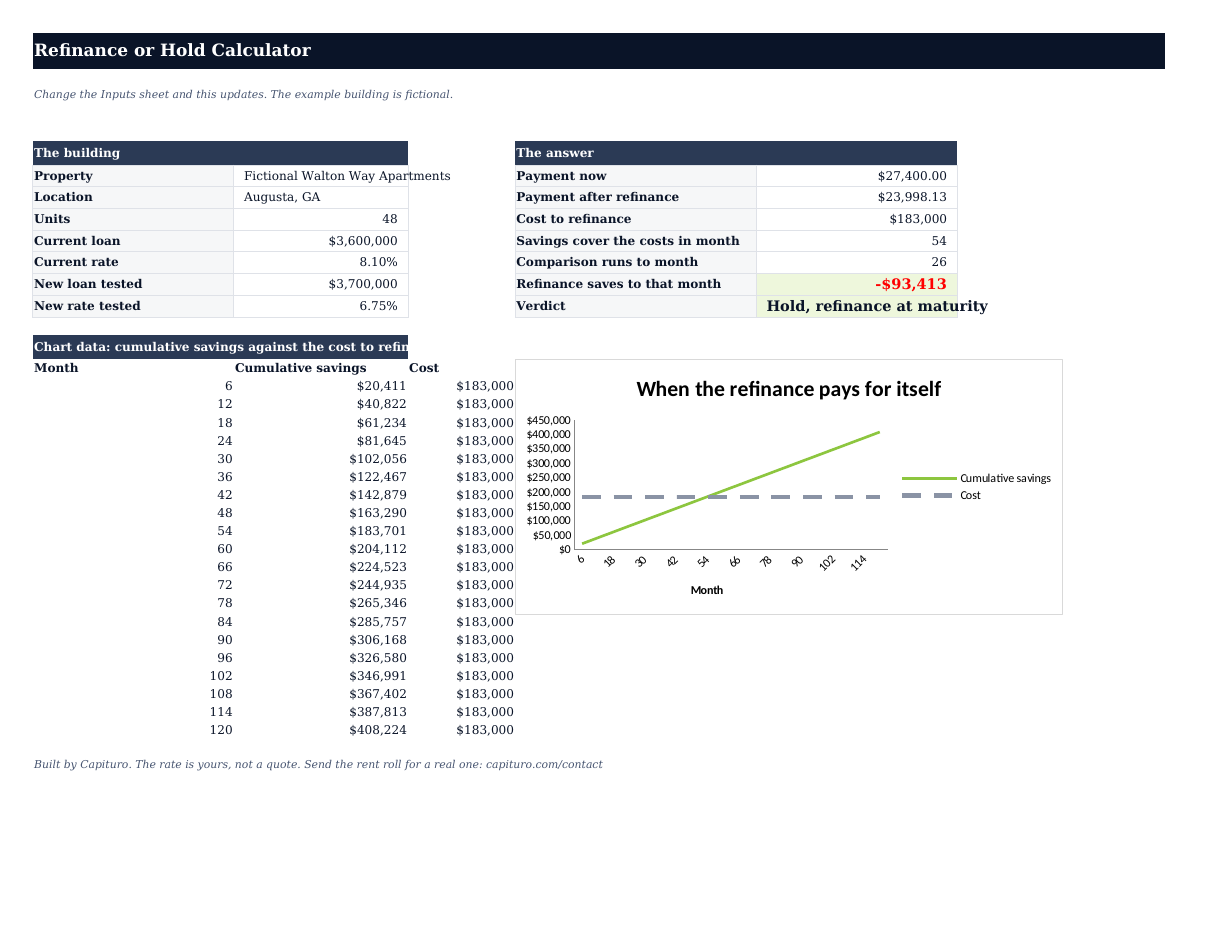
The napkin math, run both ways.
Every owner with a loan from 2022 or 2023 has done this on a napkin. The payment would drop. The penalty is still 2%. The balloon is 26 months out. Is it worth it now, or is it better to wait?
This workbook runs both paths month by month. If your current loan matures before your holding period does, the comparison stops there, because holding past that point means refinancing anyway. The example building is fictional.
- Find the month the monthly savings cover the penalty and closing costs.
- See what each path costs in total: payments, plus what you still owe, less any cash out.
- Handle a balloon or a rate reset by cutting the comparison off where the current loan ends.
- Watch the answer change across five new rates, a half point apart.
- Know how much cash you bring to close, or take out, on the new loan.
- Get a one-word verdict on the Summary sheet before you order a payoff letter.
Four sheets. Hold, or refinance.
Pale-yellow cells are yours to fill. Everything else updates on its own.
From your statement to a verdict in four steps.
- Inputs sheet
Enter the loan you have
Balance, rate, and the principal-and-interest payment from your statement. Enter the months until the loan matures or the rate resets, or 0 if it does neither. The penalty is a percent of the balance, usually on a step-down in your note.
- Inputs sheet
Enter the loan you are considering
The new amount is usually the payoff plus costs for a rate-and-term refinance, or more if you are taking cash out. Type the rate you want to test, the amortization, and closing costs. The example uses 6.75% so the formulas work. It is not a quote.
- Inputs sheet
Enter your holding period
How many months you expect to keep the building. The comparison runs to that month, or to the current loan's maturity if that comes first.
- Compare and Summary
Read the answer
Compare gives the payment change, what each path costs to the comparison month, and the break-even month. Summary puts a verdict on one page.
Two paths, to the same month.
Both loans are amortized from their current balance at a fixed rate. The monthly difference adds up, and break-even is the first month that total covers the penalty plus closing costs.
Keep the payment you have.
Payments on the current loan, plus the balance still owed at the comparison month. No penalty, and no cash in or out at closing.
Take the new payment.
The fully amortizing payment on the new loan, plus the balance still owed, less net cash at closing. When that cash is negative, you bring it, and it counts against the refinance.
If the current loan ends first, the comparison stops there.
Holding past a maturity or a rate reset means refinancing then, at whatever the rate is then. The sensitivity table repeats the answer at five new rates. Its break-even is costs divided by monthly savings, so it can differ by a month from the schedule.
A fictional 48 unit in Augusta.
These are the numbers already loaded in the workbook, so you can open it and follow along.
- Units
- 48
- Current balance
- $3,600,000
- Current rate and payment
- 8.10%, $27,400
- Months to maturity
- 26
- Prepayment penalty
- 2%
- New loan
- $3,700,000
- New rate and term
- 6.75%, 30 years
- Closing costs
- 3%
- Holding period
- 60 months
Refinance at maturity.
$27,400 down to $23,998
Month 26Costs covered
Month 54
The current loan matures in month 26. The savings cover the refinance costs in month 54, after the loan has already ended.
- Penalty
- $72,000
- Closing costs
- $111,000
- Cost to refinance
- $183,000
- From the larger loan
- $100,000
- Cash you bring
- $83,000
- Hold, total cost to month 26
- $4,224,617
- Refinance, total cost
- $4,318,031
- Refinance costs more
- $93,413
- Interest saved by then
- $89,587
| New rate | Monthly savings | Break-even month | Costs more by month 26 |
|---|---|---|---|
| 5.75% | $5,808 | 32 | $13,088 |
| 6.25% | $4,618 | 40 | $53,226 |
| 6.75%Your rate | $3,402 | 54 | $93,413 |
| 7.25% | $2,159 | 85 | $133,640 |
| 7.75% | $893 | 205 | $173,899 |
The rate drop is real. Paying for it 26 months before the loan ends on its own is the expensive part.
At maturity the penalty will be lower, and there will be no choice anyway. At 5.75% the refinance nearly breaks even by then, about $13,000 apart. The decision is really about what rates will be in 26 months, and that is the conversation to have now.
Common errors and fixes.
It says hold, but the savings look large.
Look at the comparison month. If the current loan matures soon, the savings do not have long enough to cover the costs. The workbook is telling you to wait, not that the refinance is a bad loan.
Net cash at closing is negative.
The new loan does not cover the payoff plus costs. Either raise the loan amount, if the building supports it, or plan on bringing that cash.
Break-even says not within 30 years.
The monthly savings are too small, or the new payment is higher. Check the new rate and the payment on the current loan.
The new balance is higher at the comparison month.
Normal on a new 30 year amortization. Early payments are mostly interest, and the new loan started larger.
What it covers, and what it does not.
- One current loan and one replacement loan, at fixed rates, for up to 360 months.
- A maturity or rate reset that cuts the comparison short.
- The cash you bring to close, or take out, on the new loan.
Owners with a loan from the last few years use the Compare sheet to decide whether to refinance now or ride to maturity. Owners with a balloon inside two years use it to see what the prepayment penalty is actually costing them.
Buyers use it to test an assumable loan against new debt.
When the numbers say refinance, or when they say wait and you want to know what rate would change that, send the details. Capituro will review the request with a rate that reflects the property and the sponsor.
Your working copy.
Review the inputs, formulas, and limits before adapting it. Keep the original and validate formulas after every change.
- Direct download
- No account
- Editable file
- Opens in Sheets and Numbers
Where this leads next
10+ Unit Apartment Refinance
Refinance larger apartment buildings on the property's income.
Open5 to 10 Unit DSCR
Long-term debt for smaller apartment buildings, sized on the rent roll.
OpenApartment Cash-Out Refinance Calculator
Size a cash-out refinance by value and cash flow, and see cash to you.
OpenApartment DSCR Calculator
Test whether a loan clears the lender's minimum coverage.
OpenFrequently asked
Should I refinance before my balloon?+
How is break-even calculated?+
Why does the calculator count the cash I bring to close?+
Where does the new rate come from?+
Does this replace a payoff letter or a lender's quote?+
Send the details for a real comparison.
We will review the request with a rate that reflects the property and the sponsor, rather than the placeholder on the Inputs sheet.