
Apartment cash‑out refinance calculator in Excel.
See how much loan a building supports, which limit is setting that number, and roughly how much cash comes back to you at closing.
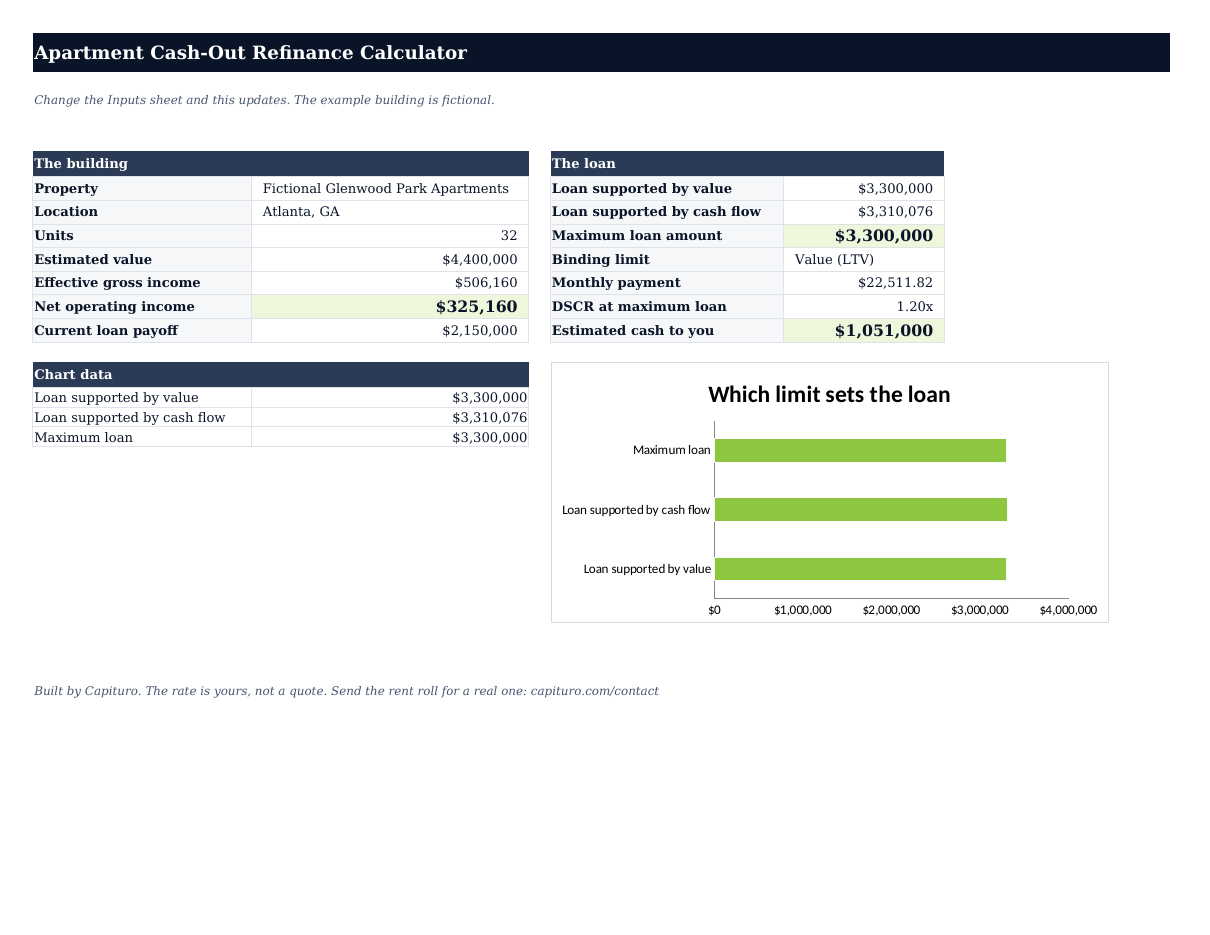
Know what a refinance produces before you ask.
Built for owners of 5 to 50+ unit apartment buildings. It takes the rent roll and the expenses, works out net operating income, and sizes the loan two ways: by the value of the building and by the cash flow it produces.
The example building is fictional. The workbook models loan amounts. It does not quote a rate or approve anything.
- See the maximum loan by value (LTV) and by cash flow (DSCR) next to each other, and which one is binding.
- Turn a rent roll and an expense list into the NOI a lender would actually use, with vacancy, management, and reserves deducted.
- Estimate cash to you after paying off the current loan and closing costs.
- Test what a half point of rate does to proceeds before you have a quote in hand.
- Find the prepayment penalty in any month of the new loan, so a planned sale in year three does not surprise you.
- Share one clean Summary page with a partner before ordering an appraisal.
Four sheets. One clear answer.
Pale-yellow cells are yours to fill. Everything else is a formula you can read and follow.
From rent roll to loan amount in four steps.
- Inputs sheet
Enter the building
Fill in legal unit count, your estimate of value, and the payoff on the current loan. Use the unit count on the county record. If a unit was added without permits, leave it out.
- Inputs sheet
Add income and expenses
Every unit at its current lease rent for twelve months, vacant units at market. Then the expenses you actually pay, plus the replacement reserve most lenders deduct. A 5% vacancy allowance applies by default.
- Inputs sheet
Set the loan terms
Type in a rate, an amortization, and the lender limits. The example uses 7.25% so the formulas work, but it is not a quote. No rate yet? Use the sensitivity table.
- Sizing and Summary
Read the answer
Sizing shows the loan by value, by cash flow, the lower of the two, and which is binding. Summary puts it on one page. Schedule shows any month you want to check.
Every cash-out refinance runs into two limits.
Most programs cap the loan at 75% of appraised value, and banks often stop at 65% or 70%. The building's NOI also has to cover the new payment by a margin, usually 1.20x to 1.25x.
The loan by value is the estimated value times the maximum LTV. The appraisal sets this ceiling.
That gives the annual debt service the building can carry. The rate and amortization turn that payment back into a loan amount.
Maximum loan is the lower of the two, rounded down to the nearest $1,000.
Cash to you is that loan, less the current payoff, less estimated closing costs. The schedule uses a fixed rate and a 30 year amortization by default, and the penalty column applies your prepayment structure to the balance in each month.
A fictional 32 unit in Atlanta.
These are the numbers already loaded in the workbook, so you can open it and follow along.
- Units
- 32
- Gross scheduled rent
- $518,400
- Other income
- $14,400
- Operating expenses
- $173,000
- Reserves
- $250 per unit
- Estimated value
- $4,400,000
- Current payoff
- $2,150,000
- Rate and term tested
- 7.25%, 30 years
- Lender limits
- 75% LTV, 1.20x DSCR
- Maximum loan
- $3,300,000
- Current payoff
- −$2,150,000
- Closing costs (3%)
- −$99,000
- Cash to you
- $1,051,000
- Monthly payment
- $22,511.82
- Loan-to-value
- 75%
- Balance at month 36
- $3,196,820
- Penalty at month 36 (3%)
- $95,905
| Rate | Maximum loan | Cash to you | Binding limit |
|---|---|---|---|
| 6.75% | $3,300,000 | $1,051,000 | Value |
| 7.25%Your rate | $3,300,000 | $1,051,000 | Value |
| 7.75% | $3,151,000 | $906,470 | Cash flow |
| 8.25% | $3,005,000 | $764,850 | Cash flow |
The two limits are within $10,000 of each other, which is common on a well run building.
A higher NOI would not raise the loan. A higher appraisal would. At 7.75%, cash flow takes over and proceeds fall to $906,470. That is the number to have in mind when the quote arrives.
The binding limit tells you what to work on.
Look for the line labeled "Which limit is binding" in the Result section of the Sizing sheet.
The appraisal is the ceiling.
Improving NOI changes your payment and your DSCR, but not the loan amount.
The building's income is the ceiling.
A higher appraisal will not help. What the building earns, and what the debt costs, will.
If the maximum loan does not change across the rows of the sensitivity table, value is binding at every rate shown, and the rate only changes your payment.
Common errors and fixes.
Cash to you is negative.
The current payoff is larger than the loan the building supports. Check the estimated value first, then the expenses. A refinance at a lower rate may still make sense as a rate-and-term loan, without cash out.
The expense ratio is under 30%.
Lenders will question it. Confirm the tax bill reflects a recent purchase, management is included even if you self-manage, and reserves are in.
The penalty is zero.
Either the prepayment structure is set to None or the payoff month is past the step-down period. On a 5-4-3-2-1 structure the penalty ends after month 60.
What it covers, and what it does not.
- One building and one loan, with up to 360 monthly periods.
- Rates from 1% to 25%, amortization from 5 to 40 years, and a payoff month from 1 to 360.
- A fixed rate divided by 12 and a fully amortizing payment.
Use the Summary sheet to decide whether a cash-out refinance is worth pursuing before ordering an appraisal or collecting a full document package. The sensitivity table gives a range to hold in mind while quotes come in.
The Schedule sheet answers the question that comes up in every hold-versus-sell conversation: what does it cost to get out in month 36?
When the numbers look right, send the rent roll, the trailing twelve months of operating statements, and the current loan statement. Capituro will review the loan request with a rate that reflects the property and the sponsor.
Your working copy.
Review the inputs, formulas, and limits before adapting it. Keep the original and validate formulas after every change.
- Direct download
- No account
- Editable file
- Opens in Sheets and Numbers
Where this leads next
Cash-Out Refinance
Take equity out of an apartment building on the value and NOI it supports today.
Open10+ Unit Apartment Refinance
Refinance larger apartment buildings on the property's income.
Open5 to 10 Unit DSCR
Long-term debt for smaller apartment buildings, sized on the rent roll.
OpenApartment DSCR Calculator
Test whether a loan clears the lender's minimum coverage.
OpenRefinance or Hold Calculator
See whether a refinance pays for itself before the current loan ends.
OpenBridge to Permanent Calculator
See whether a value-add deal pays off its bridge loan at the refinance, and how much cash comes back.
OpenFrequently asked
What does the apartment cash-out refinance calculator show?+
Where does the rate come from?+
Why is my loan smaller than 75% of the value?+
Does it work for a building under 5 units?+
Does this replace a lender's sizing or a term sheet?+
Send the rent roll for a real sizing.
We will review the loan request with a rate that reflects the property and the sponsor, rather than the rate on the Inputs sheet.