
Interest-only vs 30 year calculator in Excel.
Same building, same rate, same coverage test. See what interest-only does to the loan, the payment, and the cash you walk away with.
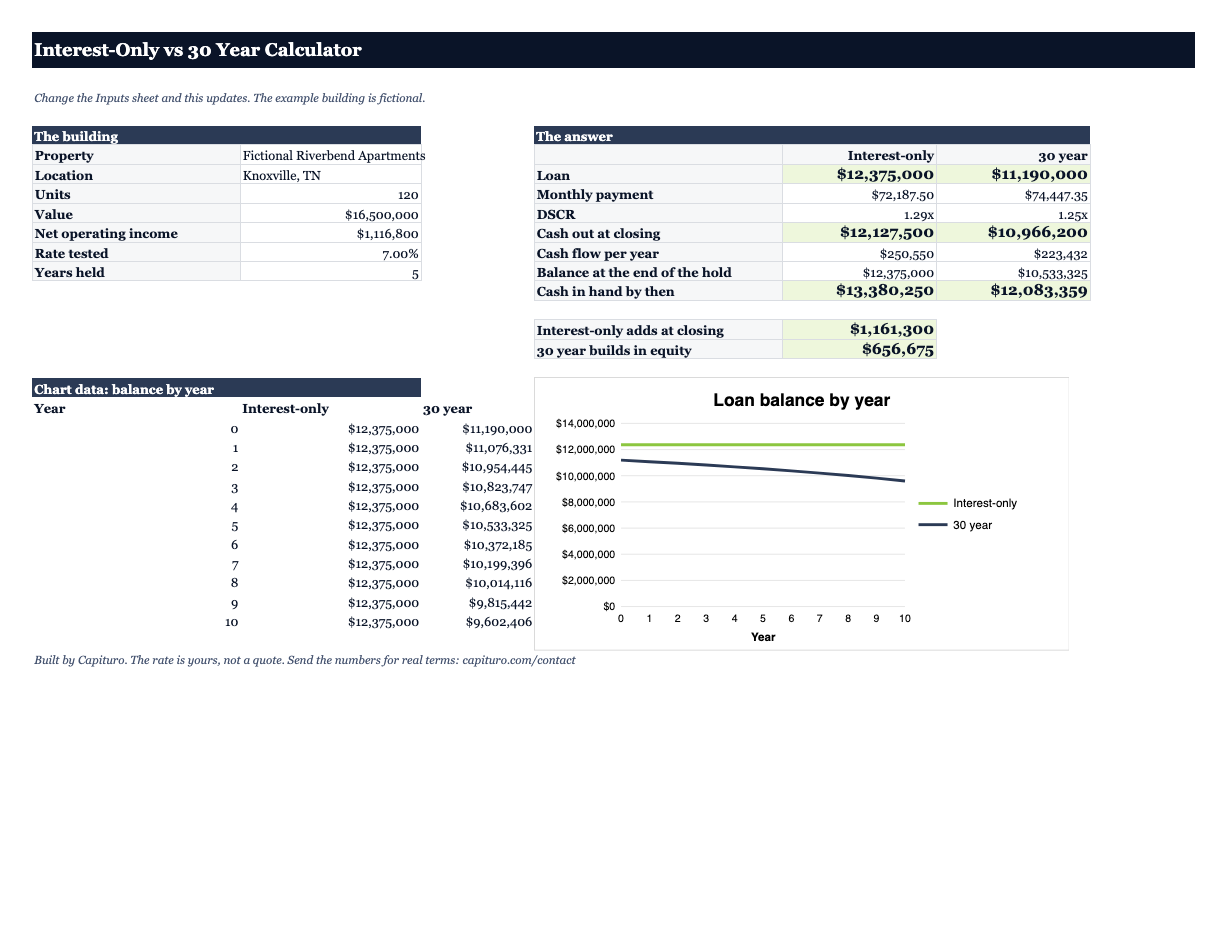
The payment decides the loan.
Every long-term apartment loan has a coverage test: the building's income has to cover the payment by a set ratio. An interest-only payment is smaller than a 30 year payment on the same balance, so the same income carries a bigger loan. This workbook shows how much bigger on your building, where the value stops it, and what you give up in principal paydown for the extra cash.
The example building is fictional. The workbook models two loan structures from your inputs. It does not quote a rate or approve anything.
- See the loan your income carries on interest-only and on a 30 year payment.
- Find out whether the income or the value is what stops each loan.
- Know the cash out at closing both ways, after the payoff and closing costs.
- Compare the monthly payment, the DSCR, and the cash flow left over.
- Watch both balances over ten years, and see the equity the 30 year payment builds.
- Test five rates and see where interest-only adds the most.
Four sheets. Two loans.
PMT, PV, FV, MIN, and ROUNDDOWN. Data validation on the inputs. Opens in Excel, Google Sheets, or Numbers. No code runs when you open it.
From the T-12 to both loans in four steps.
- Inputs sheet
Enter the building
Units and what you think the building is worth today. If you have an appraisal, use it.
- Inputs sheet
Enter a year of income and expenses
Gross scheduled rent is every unit at its lease rent for twelve months, with vacant units at market. Enter expenses as you pay them, including management even if you manage it yourself. The vacancy allowance starts at 5% and reserves at $250 a unit, because that's how underwriting treats them on a full building too.
- Inputs sheet
Enter the loan
The rate is yours to fill. The example uses 7.00% so the formulas work, but it is not a quote. Enter your current payoff, or 0 if you own the building free and clear, and how many years you plan to hold.
- Summary and Compare
Read both loans
Summary gives the answer on one page. Compare shows the work, including whether the income or the value set each loan.
One coverage test, two payments.
The workbook builds net operating income from the rent, other income, a vacancy allowance, operating expenses, and reserves. It divides that NOI by the minimum DSCR to get the most the building can pay each year. On interest-only, that payment is all interest. On a 30 year payment, part of it is principal. Each loan is then capped at the maximum LTV.
NOI ÷ Minimum DSCR ÷ Rate
The whole payment is interest, so the payment the income can carry turns straight into a loan amount. Capped at the maximum LTV.
Present value of (NOI ÷ Minimum DSCR) over 360 payments
Part of every payment goes to principal, so the same payment carries a smaller loan. Also capped at the maximum LTV.
Interest-only gets you more cash today. The 30 year payment gets you more equity later.
The Compare sheet shows both: cash in hand by the end of your hold, and what you still owe. The difference is what the extra cash has to earn to come out ahead.
A fictional 120 unit in Knoxville, owned free and clear.
These are the numbers already loaded in the workbook, so you can open it and follow along.
- Units
- 120
- Value
- $16,500,000
- Gross scheduled rent
- $1,944,000
- Other income
- $60,000
- Operating expenses
- $760,000
- Rate
- 7.00%
- Minimum DSCR and maximum LTV
- 1.25x, 75%
- Current payoff
- $0
- Years held
- 5
- NOI
- $1,116,800
- Interest-only payment
- $72,188
- Interest-only DSCR
- 1.29x
- Interest-only set by
- Value
- Balance in year 5, interest-only
- $12,375,000
- 30 year payment
- $74,447
- 30 year DSCR
- 1.25x
- 30 year set by
- Income
- Balance in year 5, 30 year
- $10,533,325
| Rate | Interest-only loan | 30 year loan | Interest-only adds |
|---|---|---|---|
| 6.00% | $12,375,000 | $12,375,000 | $0 |
| 6.50% | $12,375,000 | $11,779,000 | $596,000 |
| 7.00%Your rate | $12,375,000 | $11,190,000 | $1,185,000 |
| 7.50% | $11,912,000 | $10,648,000 | $1,264,000 |
| 8.00% | $11,168,000 | $10,146,000 | $1,022,000 |
At 7%, the income would carry $12.76 million on interest-only, more than the 75% value cap allows, so the value stops it at $12,375,000. The 30 year payment stops at $11,190,000 because the income runs out first. That's $1.16 million more in cash on interest-only, with a lower monthly payment. The 30 year loan pays down $656,675 over five years. If the extra $1.16 million goes into another building or a renovation that pushes rents, interest-only usually wins. If it sits in a bank account, it usually doesn't.
"What sets the loan" tells you what to change.
Look for "What sets the loan" on the Compare sheet.
The payment is the limit.
The building could carry more loan on its value, but the income can't cover a bigger payment at that rate and coverage.
The value is the limit.
The income could carry more, but the loan is already at the maximum LTV. This is where interest-only and a 30 year payment can end up at the same loan.
The rate table shows both at once. At 6%, both loans hit the value cap and interest-only adds nothing. At 7.5% and above, both are set by the income and interest-only adds the most.
Common errors and fixes.
Both loans come out the same.
The value set both of them. Check the estimated value and the maximum LTV. Interest-only only helps when the income is the limit.
Cash out at closing is negative.
The loan doesn't cover your payoff and closing costs. Check the payoff, or look at whether the NOI is missing income.
The loan is lower than you expected.
Check the vacancy allowance, management, and reserves. Those three lines are usually the difference between the NOI on your T-12 and the NOI underwriting uses.
What it covers, and what it does not.
- One building, one fixed rate, and two payment structures: full-term interest-only and a fully amortizing payment.
- A coverage test and a maximum LTV, with the lower of the two setting each loan.
- Up to ten years of balances, with NOI held flat.
Owners with a free and clear building use it to see how much cash comes out each way. Owners coming off a renovation use it to see whether interest-only closes the gap to their current balance.
Buyers use it to test how much the income carries before they settle on a price.
When the numbers say interest-only is worth it, or when you want to know what the building supports at a real rate, send the numbers. Capituro will review the request and come back with both structures side by side.
Your working copy.
Review the inputs, formulas, and limits before adapting it. Keep the original and check the formulas after every change.
- Direct download
- No account
- Editable file
- Opens in Sheets and Numbers
Where this leads next
Interest-Only Apartment Loans
Interest-only for up to the full term, often for more cash out.
OpenCash Out Refinance
Pull equity out of an apartment or commercial building.
OpenInterest-only or amortizing
The same math, walked through on a 140 unit building.
OpenApartment Cash-Out Refinance Calculator
Cash out by value and by cash flow, and which one is the limit.
OpenFrequently asked
How much more can I borrow on interest-only?+
Why can interest-only and a 30 year loan come out the same?+
Does the calculator handle interest-only for part of the term?+
Where does the rate come from?+
Does this replace real terms?+
See your building both ways, with a real rate.
Send the numbers. We'll come back with the interest-only and 30 year structures side by side, at a rate that reflects the building and the sponsor.